Copyright: TI Bitburger Land
Rattling before Easter
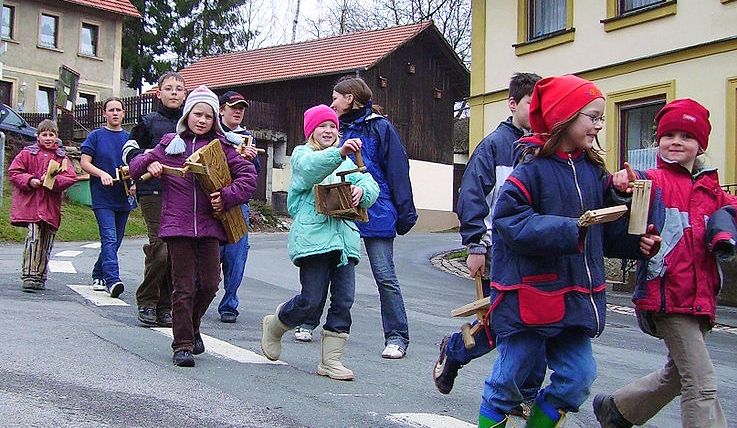
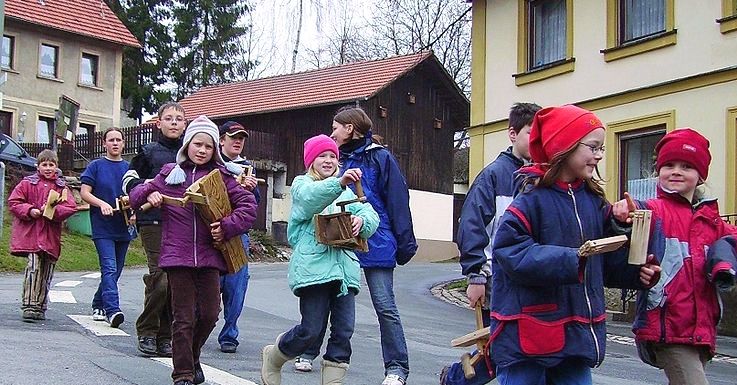
During the custom of rattling, children parade through the villages with wooden instruments during Holy Week
In the Eifel and other Catholic regions, the custom of rattling is well known and very popular with children. During Holy Week, children parade through the villages with noisy wooden instruments.
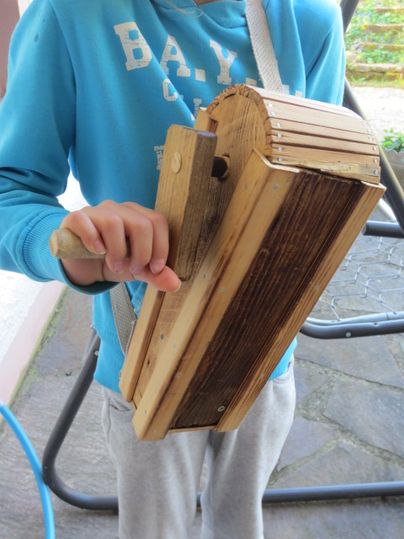
The church bells fall silent from the evening of Maundy Thursday (or more precisely, from the Gloria at Mass on Maundy Thursday). Legend has it that they fly to Rome for confession. What is meant, however, is that the festive ringing of bells is not appropriate for the sad death on the cross and the burial of Jesus Christ. To remind them of the Angelus prayer times or to call them to Mass, the children parade through the village at the appropriate times with wooden instruments: rattles. Depending on the size and the wood used, the rattles cannot be ignored, even when the windows are closed.
This was and still is the way things are done in the small Eifel village of Niederweiler:
In the past it was only the boys, there were never any girls. The leader of the group, usually the oldest child, was the "Kupphäar", in reference to the custom of burning huts. This "Kupphäar" had a whistle that was used to "blow the whistle" and "blow the whistle" again, accompanied by the respective call of all the children.
In the mornings between 6 and 8 o'clock, the children would go for the first time to replace the Angelus ringing and shout as loudly as they could "et leggt Beatglock" (the prayer bell rings). The children had particular fun when they were out and about in the morning and some of them were still asleep so that they could make as much noise as possible to wake everyone up...
At lunchtime, the children went through the village again, rattling and shouting: "et leggt Mettisch" (the bell rings at lunchtime).
And in the evening it was really exhausting: the children had to go through the village three times to represent the three ringing bells before mass. The first round they called out: "this is the first time", the second round: "this is the second time", and in the third round they said: "et leggt zu Hof", which means this is the last ringing before mass.
In the middle of the night on Easter Vigil, the older children would walk through the village clattering once more and shouting: "stitt opp, stitt opp, et as Uusderdaach" (get up, get up, it's Easter!). And "this is the last time - for this year".
And on Easter Sunday, eggs were collected from all the houses as a reward.
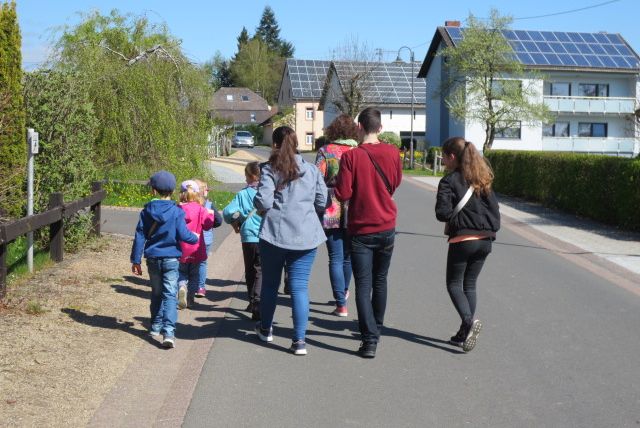
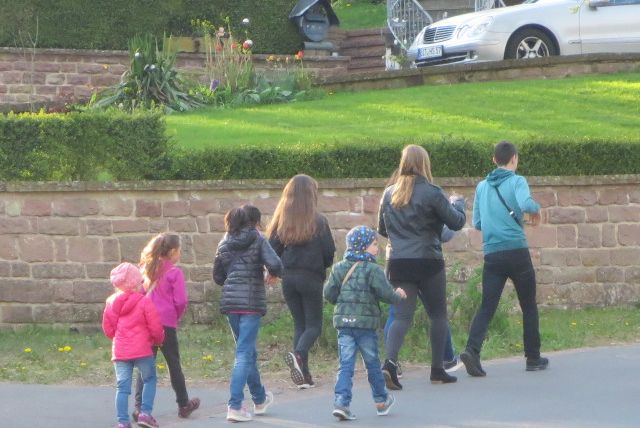
Today all children, girls and boys, from kindergarten or school age, walk through the village three times a day, at 7 a.m., 11 a.m. and 6 p.m., but usually only once in the evening, rattling and shouting the respective sayings, led by the school elder. The children have a lot of fun and compete to see who can rattle the loudest.
On the afternoon of Holy Saturday, the best round takes place: the children collect the reward for their efforts in the form of eggs, sweets and money.